Sauce Espagnole
Classic French sauce
Table of Contents
- ✨ Before We Begin…
- What Will You Learn Whilst Making This Recipe?
- Watch It Being Made
- Watch It Being Made
- The Cook’s Mind
- Ingredient Focus: Tomato Purée
- Ingredient Focus: Brown Onion Skin
- My Favourite Way To Eat
- Serving Suggestions
- Multi-Purpose Recipe
- Why You’ll Love This Recipe
- Handpicked to Go With This One
- Waste Less: How To Use Up Your Ingredient Stash!
- Sauce Espagnole Recipe
✨ Before We Begin…
Espagnole is a mother sauce — but also a teacher. It asks for care, calmness, and time. The technique is classical: a dark roux, a deep brown stock, a tomato base, and a long, slow reduction. There is no rushing this. Each element exists to coax more from less. You begin with bones and trimmings; you end with a base that could anchor a dinner party.
What Will You Learn Whilst Making This Recipe?
- You’ll learn the principles of brown stock — roasting, sweating, reducing — and understand what affects clarity and depth.
- You’ll build a traditional Espagnole sauce using a dark roux and tomato base.
- You’ll practise reducing a liquid to glaze consistency, learning the visual cues that mark a well-made demi-glace.
Watch It Being Made
The full Live Cookery Demonstration is reserved for members.
Join Black Labrador to unlock it.
‘Must be best food offer, of any genre, in Kendal. Hugely accomplished cooking and very much recommended.’
Tony P, Kendal; Food Customer
The Cook’s Mind
What This Recipe Helps You Practise
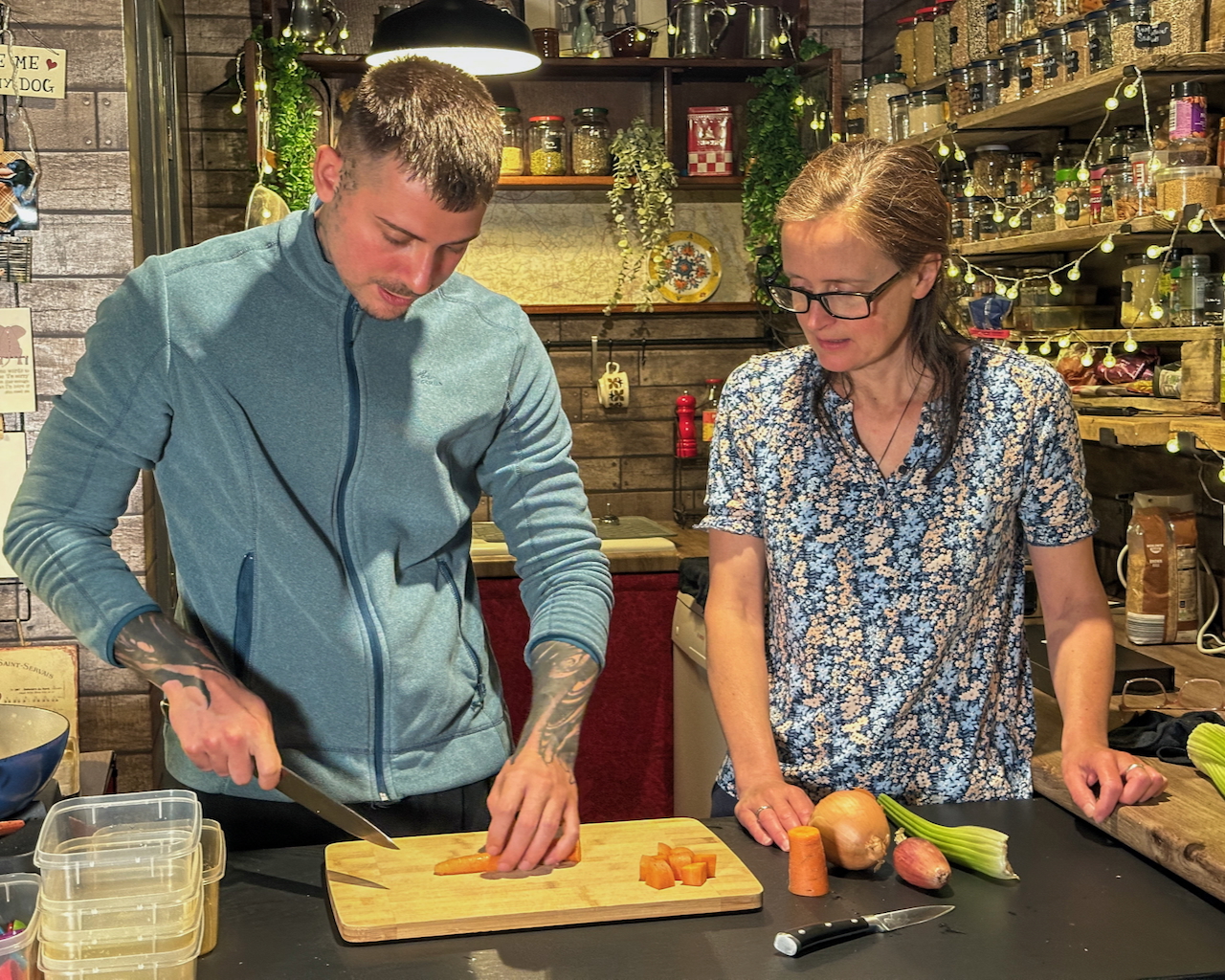
- Knife Skills: Uniform dicing of carrots, onions, celery for mirepoix
- Cooking Techniques: Making brown stock, sweating vegetables, clarifying stock, building a roux, sauce reduction
- Flavour Building: Tomato paste caramelisation, fond layering, integrating wine and aromatics
- Pan Use: Wide pan for evaporation and even browning
- Vegan Classic Technique: Creating depth and structure without bones or gelatin
Teaching Points
Download the full Teaching Points guide (print-friendly PDF)
This is not a quick sauce — but it teaches more than any other. Brown stock becomes Espagnole; Espagnole becomes demi-glace. Every stage builds on the last. Done well, it gives the kind of flavour that restaurant chefs reach for instinctively — and now, so can you.
The patience of stock work
You’ll learn to slow down — brown stock isn’t about boiling and blitzing. It’s a meditation. The restraint not to stir too often, the willingness to roast mirepoix until caramelised, the discipline to simmer low and skim often — these are the marks of a cook growing into confidence.
Trusting visual and aromatic cues
The roux and tomato stages both require intuition. Your eye will learn the difference between raw and rust-red. Your nose will learn what burnt flour smells like — and what to stop just before.
Clarity over yield
It can be tempting to press the solids or pour through a coarse sieve. But clarity comes from restraint. In a classical kitchen, this is non-negotiable. Straining with care means your sauce gleams, not gloops.
Skimming as a form of attention
This isn’t busywork. Skimming keeps bitterness at bay. It’s the cook’s quiet dialogue with the sauce — noticing what’s rising, what’s missing, and what’s ready to be let go.
The sauce becomes a teacher
Caramelising mirepoix (twice), cooking tomato purée correctly, and then simmering and reducing before adding a brown roux… this sauce teaches you many things. How things can’t always be rushed, how low is slow and good, how to get a feel for things, where classic cookery has come from…
Sauce Espagnole Timeline
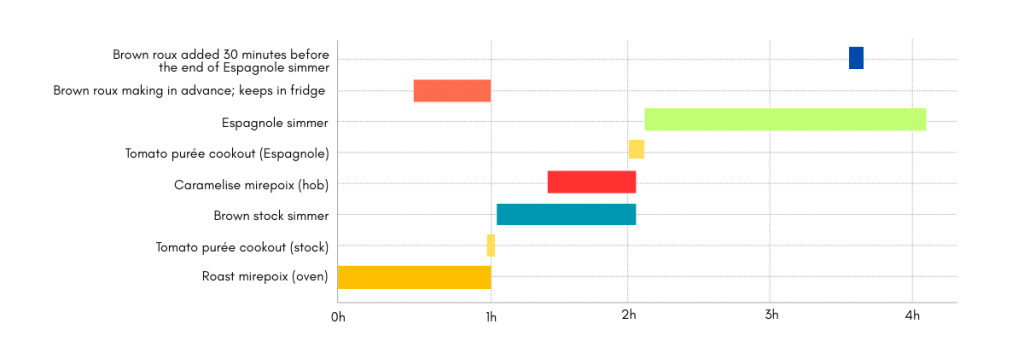
This Sauce Espagnole timeline clearly maps the traditional French method, showing how long each stage takes and where tasks can overlap to save time. From roasting and simmering the brown stock to caramelising the mirepoix, cooking out tomato purée, preparing a brown roux, and finishing with the final simmer, this visual guide helps you plan and pace the classic 4-hour sauce with confidence.
Make-Ahead
- The brown stock and roux can be made ahead.
- The sauce improves with rest. Make up to 3 days ahead and keep chilled.
Freezer-Friendly
- Freezes well in small portions. Ice cube trays work beautifully — a single cube adds magic to future sauces. Or freeze in 200ml portions.
Rescue Mission — What To Do When Things Go Wrong
- Too thin? Reduce further. Don’t add starch — this is a classical sauce.
- Too thick? Loosen with warm stock, not water.
- Flat-tasting? Add a splash of wine or a dot of miso. A little goes a long way.
Key Substitutions
- Butter: Use unsalted vegan block — not margarine.
- Stock: If brown stock isn’t ready, a strong vegetable stock with a dash of soy and mushroom liquor will work.
Cooking Parlance
- Smiling simmer — a low simmer, just breaking the surface
- Roux: equal parts fat and flour, cooked to varying degrees and used for thickening.
A Note on Origin
Espagnole is one of the five French mother sauces, formalised by Escoffier, the father of French cookery. Its name may refer to the tomato influence brought from Spanish cooking. Traditionally made with veal stock, it’s here reimagined — faithfully, but with plants — as the deepest vegan foundation sauce in your kitchen.
Ingredient Focus: Tomato Purée
Not just colour — tomato purée brings acidity, sweetness, and umami. But it must be cooked. This isn’t a fresh tomato sauce — it’s the bones of one, rust-red and thick with potential.
✨ Cooked to rust, it anchors the sauce like iron in the earth.
To Ingredient Focus: Tomato Purée
Ingredient Focus: Brown Onion Skin
Brown onion skin is one of the oldest natural colourants in cooking — a trick used in broth-making for centuries. Here, it builds a rich mahogany hue and subtle earthy undertone without overpowering the sauce.
✨ Burnished skin — the story of caramel told in rust and gold.
To Ingredient Focus: Brown Onion Skin
My Favourite Way To Eat
Poured over a Mushroom Wellington or other roast.
Serving Suggestions
- Spoon over stuffed and roasted mushrooms.
- Use to enrich shepherd’s pie or ragù.
- Fold into braised lentils for a base layer of umami.
Multi-Purpose Recipe
This recipe has more than one life…
Use it as a base, a mother, or a hidden layer in any dish that needs gravitas.
- Blend with wine and reduce for a sharp jus.
- Used as a gravy on a Sunday.
- Swirl into casseroles, stews, or roasts — even a bean chilli or ragù will thank you.
Why You’ll Love This Recipe
- It teaches restraint, care, and confidence.
- It’s your gateway to a hundred sauces — all deeply flavoured and richly textured.
- It’s a love letter to Escoffier, written in plants.
- You’ll feel like a chef, even in your own kitchen.
Handpicked to Go With This One
A few recipes that play well together — flavour friends, not just neighbours.
Waste Less: How To Use Up Your Ingredient Stash!
black peppercorns, brown onion, brown onion skin, brown stock, carrots, celery, dried thyme, fresh garlic, fresh parsley, plain flour, porcini mushrooms, roux, tomato purée
Sauce Espagnole Recipe
Sauce Espagnole
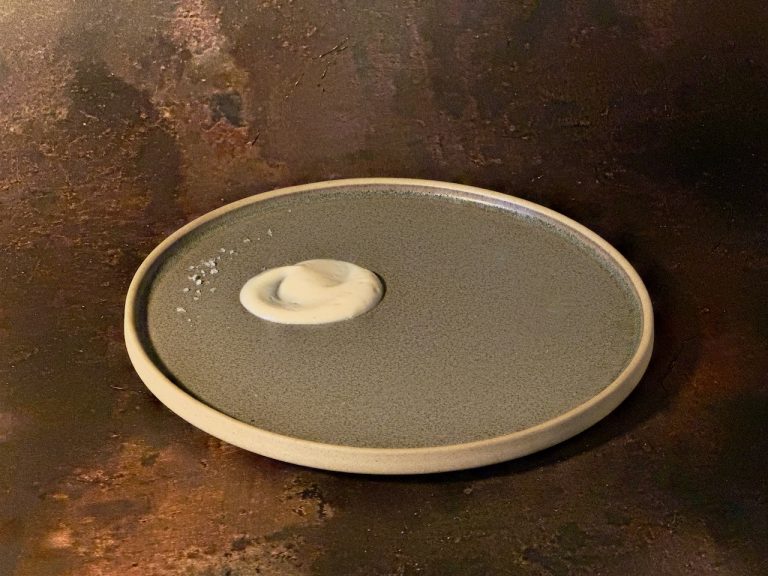
Sauce Espagnole is one of the five classical French mother sauces — and a lesson in how complexity is built from care. It begins with a strong brown stock, layered with caramelised vegetables, tomato, aromatics, and a deep golden roux. This vegan version follows tradition closely, proving there’s no need to compromise on integrity or flavour.
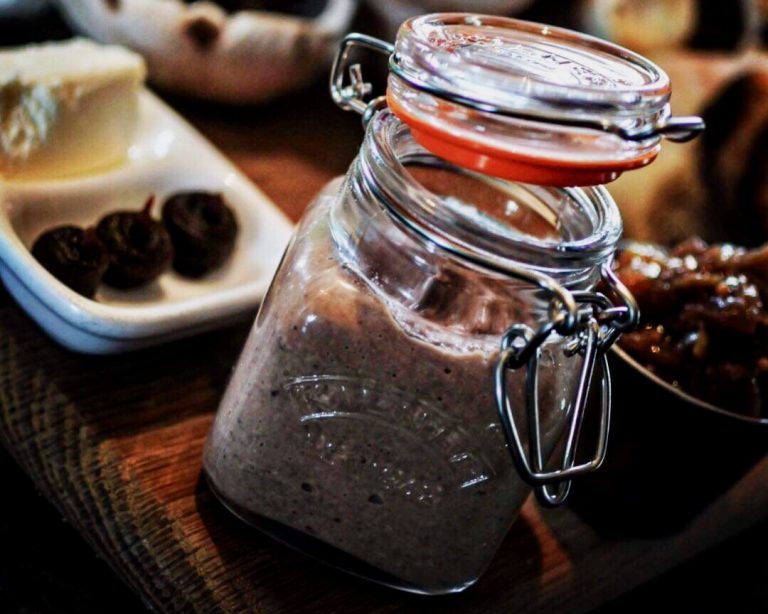
Photographed truthfully. If you cook it, yours will look like mine.
Ingredients
Brown stock: vegetables to caramelise
- 360 g brown onion | unpeeled weight; don't peel them, just chop and include the skins for colour
- 180 g carrot | unpeeled weight; rough chop
- 180 g celery | unpeeled weight; rough chop
- 10 g fresh garlic | don't peel; just rough chop with the skins in
Brown stock: other ingredients
- 20 g dried porcini mushrooms | or mixed dried mushrooms
- 200 ml hot water | to rehydrate the mushrooms
- 30 g tomato purée
- 2 bay leaves
- 6 black peppercorns | whole
- 1.8 litres cold water | it must be cold water that is poured over the oven-baked vegetables; this needs reducing to make 1.5 litres
Sauce Espagnole: vegetables to caramelise
- 20 g butter
- 140 g onion | unpeeled weight; 1 cm dice
- 70 g carrot | unpeeled weight; 1 cm dice
- 70 g celery | 1 cm dice
Sauce Espagnole: other ingredients
- 35 g tomato purée
- 1.5 litres brown stock | from above; this will reduce to approx. 1.2 litres
- 1 bay leaf
- ½ tsp dried thyme | or 2 x fresh thyme sprigs
- 6 parsley stalks
- 6 black peppercorns | whole
- 2 fresh garlic cloves
- salt | to taste
Sauce Espagnole: ingredients for the brown roux
- 60 g butter
- 60 g plain flour
Instructions
Brown stock: roast the vegetables
- Roast the onion, carrot, celery, and garlic in a 220°C fan oven (240℃ conventional) until they are a deep golden brown. Turn once if needed to ensure even caramelisation. Roasting will take around an hour.360 g brown onion, 180 g carrot, 180 g celery, 10 g fresh garlic
Prepare the dried porcini
- Pour the hot water over the dried porcini and leave to soak for a minimum of 30 minutes. Carefully lift the rehydrated mushrooms from the liquor, placing into a sieve, taking care to avoid disturbing the grit in the bottom. Carefully rinse the porcini and check them individually for grit. Retaining the porcini soaking liquor, slowly pour it through layers of fine muslin or a chinois. Your number one aim here is to have clean porcini mushrooms and 'no grit' soaking liquor.20 g dried porcini mushrooms, 200 ml hot water
Brown stock: cook out the tomato purée
- Bring the roasted vegetables out of the oven, and on a medium-low heat, add the tomato purée and stir gently for 2–3 minutes until the colour shifts from bright red to a deep rust. This step is essential – it removes the raw, metallic taste that uncooked tomato paste carries.30 g tomato purée
Brown stock: simmer gently
- Add the listed ingredients, the soaked porcini and the strained soaking liquor to the pan with the vegetables and tomato purée. Starting cold helps flavour and colour infuse slowly and ensures impurities can rise to the top to be skimmed away.2 bay leaves, 6 black peppercorns, 1.8 litres cold water
- Bring the pot to what the French call a “smiling simmer” – just a ripple on the surface. Keep it there for 45–60 minutes, skimming any scum or foam as it appears. Don’t stir once the water is in; stirring breaks down the veg and clouds the stock. Vigorous boiling will do the same.
Brown stock: strain and cool
- When the simmering time is up, strain the stock straight away through a fine sieve lined with muslin. Don’t press the solids – they’ve given their all, and pressing only clouds the liquid. Cool the stock quickly if not using immediately. You should have about 1.5 litres of clear, flavourful brown stock.
Sauce Espagnole: caramelise the mirepoix
- Melt the vegan butter in a wide pan over medium heat. Add the onion, carrot, and celery. Cook slowly for 25–30 minutes, stirring from time to time, until they are deeply caramelised. You want rich golden-brown sweetness here – not rushing, not burning.20 g butter, 140 g onion, 70 g carrot, 70 g celery
Sauce Espagnole: cook out the tomato purée
- Stir in the tomato purée and cook gently for 8–10 minutes until the colour deepens to rust. This removes any raw, metallic flavour and builds a backbone of richness.35 g tomato purée
Sauce Espagnole: add stocks and aromatics
- Pour in the brown stock and the rest of the ingredients. Bring the pan to a gentle “smiling” simmer. Stir occasionally to keep the base clear and prevent sticking, but avoid vigorous stirring – you’re aiming for calm reduction.1.5 litres brown stock, 1 bay leaf, ½ tsp dried thyme, 6 parsley stalks, 6 black peppercorns, 2 fresh garlic cloves
Sauce Espagnole: simmer with patience
- Cook uncovered for 2 hours. Keep the surface clear by skimming foam every 30 minutes. A steady, gentle simmer lets the sauce deepen without clouding.
Sauce Espagnole: instructions for the brown roux
- In a separate pan, melt the vegan butter over low heat.Add the flour and whisk steadily for 20–25 minutes until it becomes a deep golden brown, nutty, and smooth. This is your brown roux. It can be made ahead – it will last several days in the fridge if covered.60 g butter, 60 g plain flour
Sauce Espagnole: finish the sauce
- With about 30 minutes of simmering left, slowly whisk the brown roux into the sauce until fully incorporated. This step gives the sauce body and gloss.
- Continue simmering for a further 20–25 minutes, stirring often.
- Strain the sauce carefully through a chinois or fine sieve. Don’t press the solids – clarity comes from restraint.
- Adjust seasoning only at the end. Both stock and tomato bring their own salt; by waiting, you avoid over-seasoning.
Nutrition
Calories: 212kcalCarbohydrates: 26gProtein: 4gFat: 11gSaturated Fat: 2gPolyunsaturated Fat: 3gMonounsaturated Fat: 5gTrans Fat: 2gSodium: 239mgPotassium: 552mgFiber: 4gSugar: 8gVitamin A: 7322IUVitamin C: 13mgCalcium: 63mgIron: 1mg
Nutritional values are estimates only and will vary depending on specific ingredients used. Nutrition is per serving. Information is for the main recipe, not optional accompaniments.
Tried this recipe?Let us know how it was!
COPYRIGHT
© The Golden Polar Bear, 2025. Recipes and photography by Julia Savory. If you share this, please pass it along with kindness and if possible share a link back to this site. #ForTheAnimals
Photographed truthfully. If you cook it, yours will look like mine.
Next Steps?
You’ve got the full recipe — now take it further. Inside Black Labrador, you’ll find structured video courses and an ever-growing cookbook designed to help you cook with understanding, not guesswork. Learn, revisit, and deepen your skills at your own pace.
‘Totally recommend the cookery course. The meals are really tasty and full of flavour (not like most of the vegan mush I make for myself).’
Kerry B, Cumbria